Against Heresies By St Irenaeus
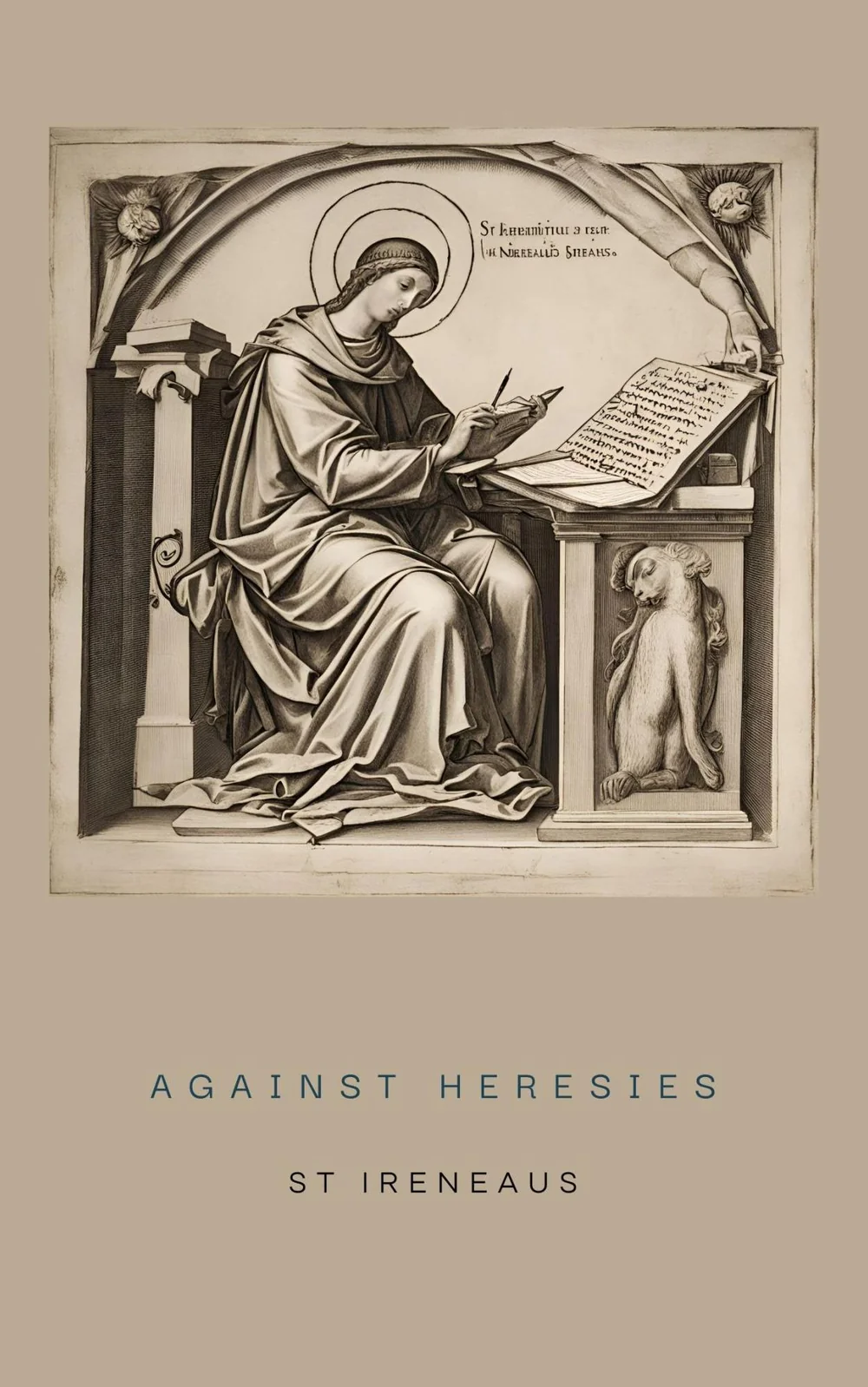
A voice from the beginning.
Written around 180 AD, Against Heresies is one of the most important surviving works of the early Christian Church. Irenaeus wrote at a moment when competing teachings were challenging the faith of Christian communities, and he responded with an appeal to the apostolic tradition he had received.
His argument was not simply that one teaching was preferable to another. He sought to show what Christianity had received from the apostles, how that teaching had been preserved, and why the faith proclaimed in the churches was inseparable from the Scriptures, the apostolic witness, and the life of the Church.
Reading Irenaeus is therefore an encounter with Christianity very near its roots. His work allows the modern reader to step backward through the centuries and hear how an early Christian bishop understood Scripture, Christ, creation, salvation, resurrection, and the continuity of the Christian faith.
Irenaeus of Lyons
Born around 130 AD in Smyrna, Irenaeus was formed within a Christian tradition that reached back to the apostles. He was a disciple of Polycarp, who had himself known the apostolic generation. That connection mattered deeply to Irenaeus. He understood Christianity not as a collection of newly invented ideas, but as a faith received, taught, preserved, and handed down.
Around 177 AD, Irenaeus became Bishop of Lyons. In a period of persecution and theological conflict, he became one of the great defenders of the Christian faith. Against Heresies was his most extensive response to the teachings he believed had departed from the apostolic message.
More than a refutation.
The Gnostic Controversy
Irenaeus examines the competing teachings of the Gnostic movements and argues for the faith preserved in the churches founded in the apostolic tradition.
Scripture and Tradition
He appeals to Scripture and to the teaching handed down through the apostolic churches as witnesses to the Christian faith.
Christ and Salvation
Irenaeus presents a deeply unified vision of Christ, creation, incarnation, redemption, resurrection, and the restoration of humanity.
The Four Gospels
His defense of the fourfold Gospel is an important witness to how early Christians understood the authority and unity of Matthew, Mark, Luke, and John.
To read Irenaeus is to hear an early Christian voice defending the faith from within the living memory of the apostolic Church.
For readers who want to go deeper.
This edition is for readers who want more than a modern summary of early Christianity. It is for anyone interested in the origins of Christian doctrine, the development of the early Church, the history of Christian theology, and the struggle to preserve the apostolic faith in the generations following the apostles.
It is also an invitation to encounter one of Christianity’s earliest major theologians directly. Irenaeus writes from a world very different from ours, yet the questions he addresses remain remarkably familiar: Who is Christ? What did the apostles teach? How should Scripture be understood? What does it mean to belong to the Church? And what does salvation actually mean?
Read the voice of the early Church.
Discover one of the foundational works of early Christian theology and encounter Irenaeus in a beautifully presented edition.
Get Your Copy at Barnes & NobleWho was St Ireneaus?
Irenaeus was born around 130 AD, likely in the city of Smyrna, which is in modern-day Izmir, Turkey. He was a student of Polycarp, who himself was a disciple of the Apostle John,(Jesus-Apostle John-Polycarp-Iraneaus) providing Irenaeus with a direct link to the teachings and traditions of the apostles. This connection to apostolic tradition deeply influenced Irenaeus’s theological outlook and his commitment to preserving orthodox Christian doctrine.
Around 177 AD, Irenaeus became the Bishop of Lyons (Lugdunum) in Gaul, modern-day France, succeeding Pothinus after his martyrdom. His leadership was crucial in stabilizing the Christian community in Lyons, especially during periods of intense persecution. As bishop, Irenaeus played a pivotal role in guiding and defending the early Christian community.
Major Works and Teachings
Irenaeus’s most notable work is “Against Heresies” (Adversus Haereses), written around 180 AD. This comprehensive treatise was aimed at refuting Gnosticism, a major heretical movement that posed a significant challenge to early Christian orthodoxy. Gnosticism proposed a dualistic worldview and claimed that salvation was achieved through secret knowledge (gnosis). In “Against Heresies,” Irenaeus systematically described the various Gnostic sects and their beliefs, critiqued their philosophical and theological underpinnings, defended the apostolic tradition, and affirmed the unity of the Old and New Testaments.
In his defense of the apostolic (concepts, traditions, and teachings that are derived directly from the apostles of Jesus Christ) tradition, Irenaeus emphasized the importance of apostolic succession. He argued that the true teachings of Christianity were passed down from the apostles to their successors, the bishops. This unbroken transmission of church authority was a key argument against the Gnostic claims of possessing secret knowledge. Irenaeus also defended the authority of the four canonical Gospels—Matthew, Mark, Luke, and John—against the use of other so-called gospels promoted by Gnostic groups.
Irenaeus believed in the coherence and unity of the Old and New Testaments, asserting that the same God was revealed in both. This stood in stark contrast to the Gnostic view that the Old Testament God was different from the New Testament God. He taught that Jesus Christ was the fulfillment of Old Testament prophecies, emphasizing continuity in God’s plan for humanity. His Christology affirmed the full divinity and humanity of Jesus Christ, countering Gnostic views that denied the physical reality of Jesus.

About This Book
*Against Heresies* is a faithful modern presentation of the early Christian classic by Irenaeus, written to refute false teachings and defend apostolic truth. This edition preserves the clarity of the original text while making it accessible to today’s readers.
Available as a convenient eBook through Barnes & Noble for instant download.


